Western Regional Honors Conference
Abstract
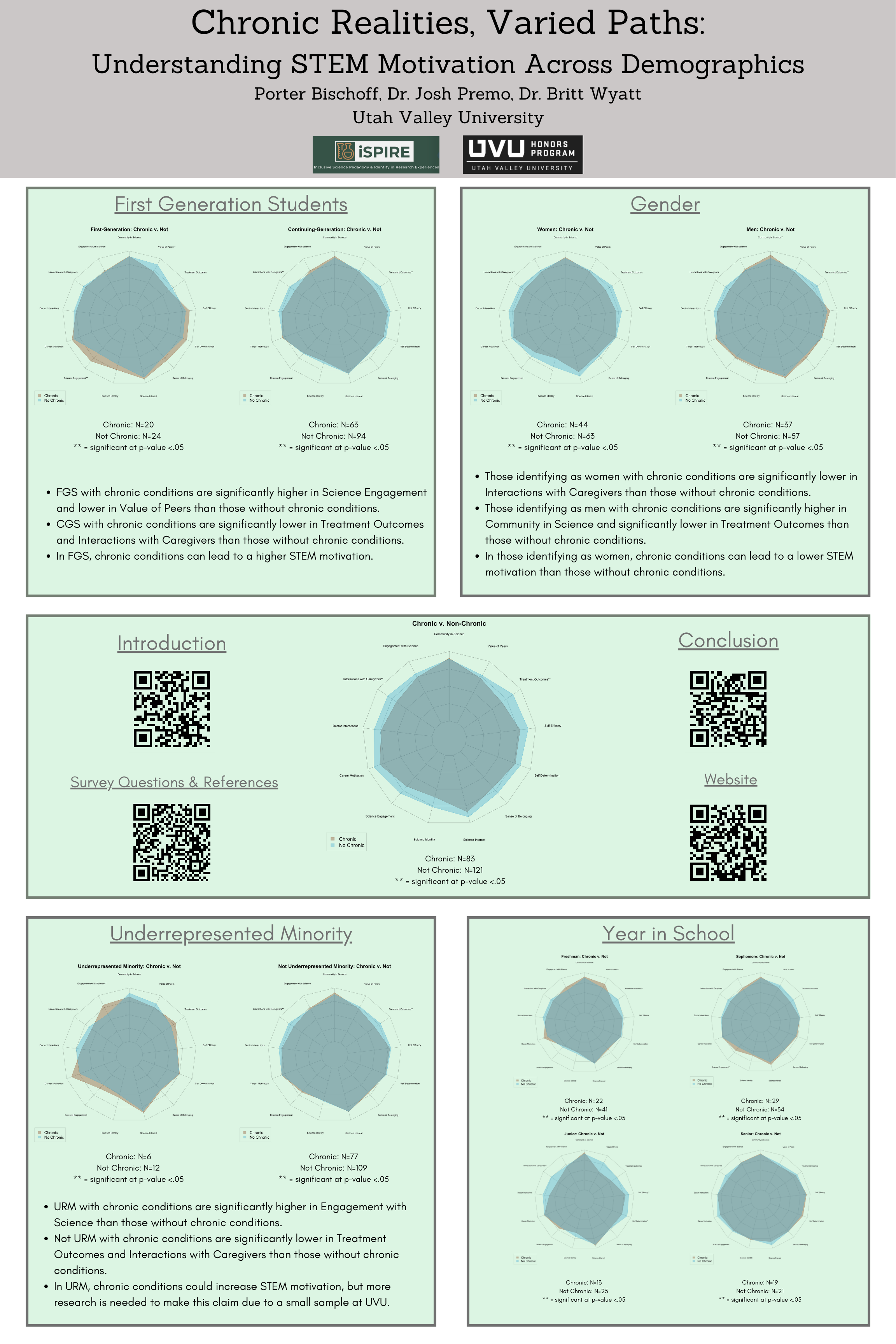
This study explores the impact of chronic conditions on STEM motivation among undergraduate students, addressing a gap in existing research that primarily focuses on gender and ethnicity. Specifically, we investigate how medical experiences, especially chronic conditions, influence students in science classes at an open enrollment institution, considering demographics such as first-generation status, gender, major, and career goals.
Data from 390 students across 14 biology courses, including non-majors, were collected before and after the courses. Surprisingly, 57% reported medical experiences, with 22% having chronic conditions, emphasizing their significance within the diverse student population.
Students facing more medical interruptions exhibited a notable decrease in their sense of belonging and self-efficacy, albeit with a small effect size. Intriguingly, across demographics, students with chronic conditions engaging more with science showed significantly higher levels of motivation and immersion. This suggests that chronic conditions can both positively and negatively influence student engagement with science.
The impact of medical interruptions on academics is closely linked to students’ sense of belonging and self-efficacy.
However, increased engagement with science due to chronic conditions may motivate students to explore these experiences within the context of scientific inquiry.
Understanding how chronic conditions shape students’ motivation is crucial for science instructors to adapt their course content and pedagogy, fostering inclusivity and recognizing diverse identities across different demographic dimensions.
Background
Motivation for the Project
Porter has had a slew of medical experiences, and these experiences led him to pursue a career path in medicine. While going through his undergraduate experience, preparing for medical school, he found a real passion for science as well as medicine. Because this was relatively late in his education, he wishes that he knew this passion he had before his undergraduate studies. Therefore, this project was born, hoping to find that Porter wasn’t uncommon in his experience and assisting other students understand their passions for science sooner than later. To learn more about how this project became to be, please go to this link!
Methods
We used an adapted survey from other literature to find information regarding STEM motivation. This survey was given pre-semester and post-semester to 14 different Biology courses at Utah Valley University. These classes had students who were both STEM majors and non-majors, as these classes were generally General Education classes. Utah Valley University is an open enrollment institution, making this data an interesting set to explore.
390 students answered the pre/post-semester surveys. We have a large number of pre-semester data, but only 390 responded to both the beginning and end of the semester survey.
STEM Motivation Questions
Here are the questions that we asked to determine the different aspects of STEM motivation.
| Category | Statement |
|---|---|
| Science Identity | I see myself as a biology person. |
| Science Identity | I see myself as a science person. |
| Science Identity | I see myself as a scientist. |
| Science Identity | Other people (friends/family) see me as a science person. |
| Science Identity | My science instructors see me as a science person. |
| Career Motivation | Learning science will help me get a good job. |
| Career Motivation | Understanding science will benefit me in my career. |
| Career Motivation | Knowing science will give me a career advantage. |
| Career Motivation | I will use science problem-solving skills in my career. |
| Career Motivation | My career will involve science. |
| Instrinsic Motivation | Learning science is interesting. |
| Instrinsic Motivation | I am curious about discoveries in science. |
| Instrinsic Motivation | The science I learn is relevant to my life. |
| Instrinsic Motivation | Learning science makes my life more meaningful. |
| Instrinsic Motivation | I enjoy learning science. |
| Self-Determination | I study hard to learn science. |
| Self-Determination | I prepare well for science tests and labs. |
| Self-Determination | I put enough effort into learning science. |
| Self-Determination | I spend a lot of time learning science. |
| Self-Determination | I use strategies to learn science well. |
| Self-Efficacy | I am confident that I will do well on science labs and projects. |
| Self-Efficacy | I believe I can earn a grade of 'A' in science. |
| Self-Efficacy | I am confident I will do well on science tests. |
| Self-Efficacy | I believe I can master science knowledge and skills. |
| Grade Motivation | Scoring high on science tests and labs matters to me. |
| Grade Motivation | It is important that I get an 'A' in science. |
| Grade Motivation | I think about the grade I will get in science. |
| Grade Motivation | Getting a good science grade is important to me. |
| Grade Motivation | I like to do better than other students on science tests. |
| Value of Peer Interactions | My college science classes are more enjoyable when I work with other students. |
| Value of Peer Interactions | I understand more when my classmates participate in college classroom discussions. |
| Value of Peer Interactions | I learn best in college science classes when I work with classmates. |
| Value of Peer Interactions | The amount I understand is increased by classmates' ideas in my college science classes. |
| Value of Peer Interactions | When classmates share their ideas in college science classes, this helps me learn. |
| Sense of Belonging | When I am in a science setting, I feel a connection with the science community. |
| Sense of Belonging | When I am in a science setting, I feel respected. |
| Sense of Belonging | When I am in a science setting, I feel comfortable. |
| Sense of Belonging | When I am in a science setting, I trust my instructors to be committed to helping me learn. |
| Sense of Belonging | When I am in a science setting, I enjoy being an active participant. |
| Sense of Belonging | When I am in a science setting, I try to say as little as possible. |
| Competency in Science | I am good at solving complicated scientific problems. |
| Competency in Science | I read websites articles or books about scientific issues. |
| Competency in Science | I work on a project involving scientific concepts. |
| Competency in Science | I think about how my life is affected by science. |
| Community in Science | To what extent is serving the community important to scientific work? |
| Community in Science | To what extent is working with people important to scientific work? |
| Community in Science | To what extent is helping others important to scientific work? |
| Community in Science | To what extent is connecting with others important to scientific work? |
Statistical Analysis
We used paired and upaired T-Tests to properly understand the significance data for each of the aspects. We are excited to continue doing analysis on this data set, as we know that we can dive deeper into it.
Technology
SPSS was used to complete the Pearson Correlation. R packages were used to create the plots.
Conclusion
R Code
The code for the creation of the Spider Plots can be found at this link!
References
- Bessette, A., Morkos, B., & Sangelkar, S. (2016, August). Motivational differences between senior and freshman engineering design students: A multi-institution study. In International Design Engineering Technical Conferences and Computers and Information in Engineering Conference (Vol. 50138, p. V003T04A014). American Society of Mechanical Engineers.
- Dika, S. L., & D’Amico, M. M. (2016). Early experiences and integration in the persistence of first‐generation college students in STEM and non‐STEM majors. Journal of Research in Science Teaching, 53(3), 368-383.
- Starr, C. R. (2018). “I’m not a science nerd!” STEM stereotypes, identity, and motivation among undergraduate women. Psychology of Women Quarterly, 42(4), 489-503.
- Starr, C. R., Hunter, L., Dunkin, R., Honig, S., Palomino, R., & Leaper, C. (2020). Engaging in science practices in classrooms predicts increases in undergraduates’ STEM motivation, identity, and achievement: A short‐term longitudinal study. Journal of Research in Science Teaching, 57(7), 1093-1118.